
Pericles of Athens
Key Ideas
- Sparse sources turn historical figures into Rorschach tests, every era projects its concerns onto the gaps
- Sparta was more popular than Athens as a political model partly because it was more legible: one Plutarch Life vs. eight
- Hobbes translated Thucydides in the 1620s while incubating Leviathan, the canonical English Thucydides was prepared by a man hostile to its politics
- Pericles' modern rehabilitation rode the wave of better Thucydides translations and the 19th-century reappraisal of classical Athens
Overview
Pericles of Athens is Vincent Azoulay’s 2014 biography of the Athenian statesman, translated into English in 2017. Azoulay is a professor at the École des Hautes Études en Sciences Sociales in Paris and editor-in-chief of the journal Annales. Histoire, sciences sociales.
This volume probably functions well enough as a short history of Pericles, but honestly, if you have read Thucydides and his life in Plutarch you already know most of what is covered here, save for the last two chapters on the historiography of the figure.
Someone trying to write a biography of a figure like Pericles is giving themselves a hard task. Pericles sits right on the edge of history. We have surviving accounts of his life, but they are partial and do not give a full picture of the person. With this very finite set of input information, what is a biographer to do?
One solution would be to try and connect Pericles to the modern day and view him as part of our collective Greek ancestry. Azoulay wants to have no part of such a project:
Faced with such a diagnosis, what room for maneuver remains for a historian? Should one launch into an apology for Pericles or, on the contrary, expose him to public contempt in the hope of provoking some debate? To limit oneself to such an alternative would be intellectually questionable and, in any case, be doomed to failure. Rather than attempt by any means to reconnect Pericles to the present world and establish him as our great ancestor, perhaps it would be better first to accept his radical strangeness so as to restore to his “all too white statue” the vivid colors that it has lost and, above all, accept that he has no useful lessons for our times. (Location 5733-5739)
Another approach is to accept that the sources are thin and treat that thinness as a license. The known facts become fixed points; the spaces between them are whatever the author wants to project. The figure becomes a Rorschach test, a puppet for whatever morality tale the author wants to tell. This has a long history (cough, Plutarch), and as we will see, the reception of a figure is itself revealing.
Azoulay’s solution is to try and do his best to reconstruct the man, contextualized by his time, using the available sources. This is a challenging ask as the sources that we do have are already one step removed from Pericles and have clear gaps.
For what can be said about Pericles’ youth prior to 472, the date when he financed Aeschylus’s Persians? What do we really know of his life between 461 and 450? No linear account of the stratēgos’s life is conceivable—unless, that is, one cheats with the information provided and arranges it into a chronological order that, although coherent, is arbitrary. Only the last three years of his existence, from 432 to 429, rise to the surface in this ocean of ignorance, and they do so thanks to the unique shaft of light shed by Thucydides’ Peloponnesian War. Does this amount to an insurmountable defect that rules out writing any book about Pericles? Not at all. (Location 551-557)
While these gaps do not prevent one from writing a book on Pericles, it does limit the author’s ability to have anything interesting to say. What we have to work with is what has survived, Thucydides and Plutarch, one of these already being a synthesis that in part draws from the other. What is left for a modern author is either to use the subject as a mirror (the approach rejected by Azoulay) or to do your best to fill in the gaps with unverifiable hypotheses and speculation:
It is at this point that a historian is obliged to abandon the solid ground of certainties and venture into the fogs of speculation and hypothesis. Let us start with the misadventures of… (Location 3261-3262)
Azoulay is up front about this, but it does not make for satisfying reading.
After that first burst of glory, Pericles remained in the shadows for several years. Was it for fear of being ostracized as his father, Xanthippus, had been? That is Plutarch’s version of the matter (Pericles, 7.1), but it is not possible to corroborate what he says… (Location 856-859)
The reasons why Pericles involved himself personally in this process remain to be determined. Was he motivated by purely political aspirations, as an honest defender of the interests of the people? That is by no means certain. (Location 881-883)
One area where this book does go beyond those two sources is by incorporating what additional evidence we do have from surviving inscriptions. These help fill in some of the blanks of his early life:
Pericles tested out those various assets for the first time in 472 B.C., when he was just twenty-one or twenty-two years old. Thanks to an inscription engraved in the fourth century (IG II2 2318), which lists the victors in the Great Dionysia, we know that in that year he was designated a khorēgos and that he, in association with Aeschylus, was declared the victor. (Location 802-808)
Inscriptions also provide one of the few independent checks on Plutarch around the politics of civic construction, and they cut both ways. Sometimes they deflate him. Plutarch (Life of Pericles 13.7–8) tells the story of a workman injured during construction of the Propylaea, healed after Pericles received a goddess in a dream prescribing treatment, and credits Pericles personally with setting up the bronze statue of Athena Hygieia on the Acropolis in commemoration. The surviving foundation stone tells a different story:
Whereas Plutarch presents Pericles as the one who dedicated the monumental statue of Athena Hygieia, the foundation stone discovered on the Acropolis mentions only the Athenian people; the name of the stratēgos does not appear at all. (Location 3712-3715)
Other times the inscriptions corroborate a pattern that Plutarch records. In Life of Pericles 14, Plutarch describes a familiar piece of political theatre. Attacked by Thucydides son of Melesias for spending recklessly on public works, Pericles offered to fund the buildings himself and put his own name on the dedications:
Thucydides and his party kept denouncing Pericles for playing fast and loose with the public moneys and annihilating the revenues. Pericles therefore asked the people in assembly whether they thought he had expended too much, and on their declaring that it was altogether too much, “Well then,” said he, “let it not have been spent on your account, but mine, and I will make the inscriptions of dedication in my own name.” When Pericles had said this, whether it was that they admired his magnanimity or vied with his ambition to get the glory of his works, they cried out with a loud voice and bade him take freely from the public funds for his outlays, and to spare naught whatsoever.
A fragment of an Athenian decree from 440–430 B.C. shows the same call-and-response in miniature, this time over a fountain at Eleusis: Pericles and his sons were honored for the proposal, but the city itself paid the costs out of tribute.
A fragment of a decree dating from 440–430 B.C. mentions the provision of a fountain at Eleusis and explains how the project was financed: the Assembly decided to honor Pericles, Paralus, and Xanthippus, and his other sons, but to meet the costs by drawing on the money paid as tribute. Although fragmentary (the name of the stratēgos has been restored by epigraphists), this inscription does make it possible, with a certain degree of likelihood, to trace the process that led to the fountain’s construction. (Location 3722-3734)
Azoulay does his best to produce a fair reading of Pericles without bringing in his own ideological baggage. In the final analysis he rode an existing wave of Athenian imperialism rather than being responsible for it. He was a prominent politician with significant power, who did his best to try and steer the assembly, but was never a king in all but name.
In this respect, Pericles’ career symbolizes a point of equilibrium just as much as a moment of rupture: to the Athenians, his death seemed to mark the end of an era. To be sure, it was far from being a total reversal, for the demagogues who succeeded him were by no means newcomers who had emerged from the gutter and now proceeded to turn the city upside down! Nevertheless, they were the first leaders who explicitly paraded their close social and cultural ties with the people, thereby incurring the wrath of members of the traditional elite, who still clung on to their own distinction. Indeed, the death of the stratēgos brought about not so much a revolution, but rather a revelation. Once Pericles had gone, it was no longer possible to deny the plain fact: pace Thucydides, Athens certainly was now, in fact as well as in name, a democracy (Location 4042-4053)
The Reception of Pericles
Where the author does have a real contribution is in the final two chapters, which cover the interpretation and reception of Pericles from the 15th century to the 21st century. This is an interesting story to tell that touches upon a few themes including the rediscovery of the Ancients, and the changing image when using history as a mirror.
One of the structural factors driving this was the relative lack of attention to Thucydides compared to Plutarch, a trend from the Renaissance through the Enlightenment. Thucydides is hard in the original and had an often circuitous route into the vernacular. In 1629 Thomas Hobbes (yes, that Hobbes) produced a translation of The History of the Peloponnesian War; before this, the only available English translation was a translation from the French translation, which was itself based on a Latin translation.
To translate this work by Thucydides was by no means an obvious thing to do, for the Greek historian aroused scant interest in Tudor England except among a few scholars, such as Francis Bacon (Location 4457-4459)
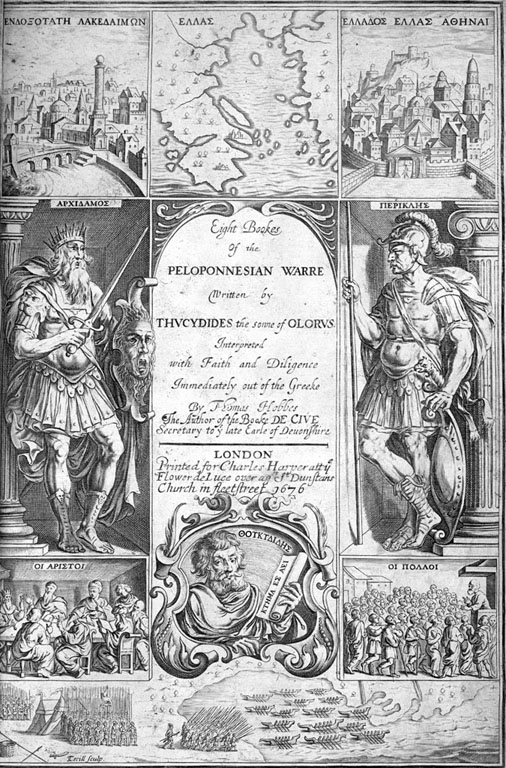
Hobbes is not just a trivia note - he is also part of the reception story. He was working on the translation in the 1620s, while developing the political theory that would later crystallize as Leviathan, work deeply skeptical of popular rule. The canonical English Thucydides was thus being prepared by a man whose own verdict on Athenian democracy ran in the opposite direction to the message of Pericles’ funeral oration (Thucydides 2.34–46).
In France Thucydides remained the least appreciated of the ancient historians, though Azoulay (citing the historian Chantal Grell) somewhat hyperbolically calls him “the major victim of the Enlightenment”. He received a loose translation in 1662 by Nicolas Perrot d’Ablancourt, with no additional French translation coming until that of Pierre Charles Lévesque in 1795. In contrast, Plutarch was part of the canon for elite education and was widely read - often providing the bulk of Greek history during an education. A new accessible translation of Life of Lycurgus came in 1721.
This meant that others covered in the Parallel Lives would pull focus away from Pericles (e.g. Solon, Cimon, Phocion), and there is more to the ancient world than just Athens. Rome and Sparta were also available as potential models for inspiration, a rich thread drawn on during the French and American revolutions.
Sparta had another advantage over Athens. In a world without Wikipedia and only just birthing the Encyclopédie, the entire history of Sparta could be read in the Life of Lycurgus (and Life of Lysander), whereas Athens’ history was spread over eight Lives. Reduced to a single survey, Sparta was a more legible model and allowed for easier philosophical generalizations than the messy constitutional developments of Athens.
Rousseau, in his Discourse on the Sciences and the Arts, called Sparta “a Republic of demi-gods rather than of men,” with Athens its foil as a land of vices and fine arts. (Location 4569-4576)
Rome more than Greece was the preferred cultural touchpoint in revolutionary France — a trend driven in part by structural factors. Latin rhetoric was taught by Jesuits, and for those who had received a solid grounding in law (e.g. Danton, Robespierre, Saint-Just), the law taught in France in the eighteenth century was essentially Roman. Their only real exposure to Greece would be Plutarch, relatively little compared to the exposure to Latin culture.
When the revolutionaries did refer to the Greek world, they usually favored Sparta. Among the Montagnards, this was perfectly clear; according to Robespierre, the city of Sparta “blazed like a streak of lightning through the immense darkness,” illuminating humanity and revealing the path to follow (Location 4708-4716)
Finally the audience itself was much less sympathetic to Pericles and the Athenian democracy - if you have an antidemocratic bias it’s not hard to read the story of the Peloponnesian War as a morality tale of unrestricted democracy in Athens leading to its downfall. Alexander Hamilton, in the Federalist Paper No. 6, launched a direct attack on Pericles that hit the main anti-Pericles notes:
“The celebrated Pericles, in compliance with the resentments of a prostitute, at the expense of much of the blood and treasure of his countrymen, attacked, vanquished and destroyed the city of the Samians. The same man … was the primitive author of that famous and fatal war which, after various vicissitudes, intermissions and renewals, terminated in the ruin of the Athenian Commonwealth. (Location 4778-4785)
Pericles’ rehabilitation was largely driven by a growing familiarity with Thucydides once better translations were available, in combination with a reappraisal of classical Athens. This reappraisal was driven by different factors in different countries. Unlike France, Germany leaned Greek rather than Roman, and within Greece, Athens over Sparta — helped by the fact that the surviving Athenian artistic legacy is far richer than the Spartan one (which is essentially nonexistent).
The German art historian Johann Joachim Winckelmann, often credited as a founder of modern art history and classical archaeology, played an early role in this elevation. His 1755 Reflections on the Painting and Sculpture of the Greeks helped seed the cult of fifth-century Athenian art that Pericles would later be carried along by:
As early as 1755, Winckelmann was presenting an enchanted view of the Athenian art of the mid-fifth century, a view with which Pericles was closely associated. Elsewhere in Europe, it was not until the following century that there appeared a magnified image of Pericles in the guise of a great bourgeois parliamentarian. (Location 4890-4896)
With the changing attitudes towards democracy and the development of liberalism, British liberals could see in Athens the seeds of their own political order, with Pericles astride the city’s golden age:
The monumental History of Greece written by the liberal historian George Grote… in any case, his success was such that the English of the second half of the nineteenth century sometimes saw themselves as Athenians dressed in frock coats and top hats. This trend to draw comparisons peaked in George Cox’s History of Greece, published in 1874, in which Periclean Athens was presented as a blueprint for Victorian England and its maritime empire. On the basis of the Thucydidean funeral oration, Cox declared, somewhat sanctimoniously, All the special characteristics of English policy—its freedom of speech, the right of people to govern themselves … may be seen in equal development in the policy of Athens. (Location 5224-5230)
Meanwhile in Germany Pericles’ reputation benefited from a surge in popularity of Thucydides, with the founders of Altertumswissenschaft, the “science of Antiquity”, admiring his work. This admiration for Thucydides had spillover effects on both Athens and Pericles. By the time of Ernst Curtius’s multivolume Griechische Geschichte (1857–67) ,the standard German history of Greece for a generation, Pericles was a ‘statesman as well as a philosopher’ embodying a ‘perfect combination of democracy and monarchy.’ (Location 5293-5311)
Conclusion
Beyond a few hints from inscriptions, contemporary scholarship has little to add to Thucydides and Plutarch — the sources simply did not survive. For an author like Azoulay, who refuses to project, all that is left is carefully hedged speculation.
The payoff of this book was the last two chapters, showing how every era’s reception of Pericles was a portrait of the era reading him. A tyrant manipulated by a prostitute for Hamilton, a frock-coated parliamentarian for the Victorians, a philosopher-king for the German classicists. As an anglophone reader in 2026 it is hard not to default to Athens as the home team and Pericles as its captain. But it is worth remembering how much the well-ordered Sparta of Lycurgus was once admired, and that a reading of Pericles as the architect of Athenian imperial overreach is perfectly consistent with what you would take from Plutarch.
This is the real methodological lesson from the book, but we are talking about metahistory here. If that interests you, read this book; otherwise, read the sources.
Related Reading
- The Landmark Thucydides - the primary source. The argument of this post is that you will learn more about Pericles by reading Thucydides directly than by reading a modern biography.
- Plutarch, Life of Pericles - the other primary source, available as part of the Parallel Lives.