“But here I will give you a brief Modell of the Government of the Common-wealth or Free-State of Ragouse, scituated in Dalmatia, near the Bottom of the Adriatick or Gulph of Venice.”
— J.S. Streater, Government Described (1650–1670)
While not as well known today as its most serene rival to the north, the Republic of Ragusa (modern day Dubrovnik, Croatia) 1. You may recognize it by sight if not by name as the old city was used to film King’s Landing in Game of Thrones. was a well managed and prosperous merchant republic that has been relegated to the history books. 2. I say books but there is really only a single general history of the city in print in English: Robin Harris’s “Dubrovnik: A History”. I hope in this and the following posts to do my small part to boost awareness of this republic which faded away during the birth of the modern age.
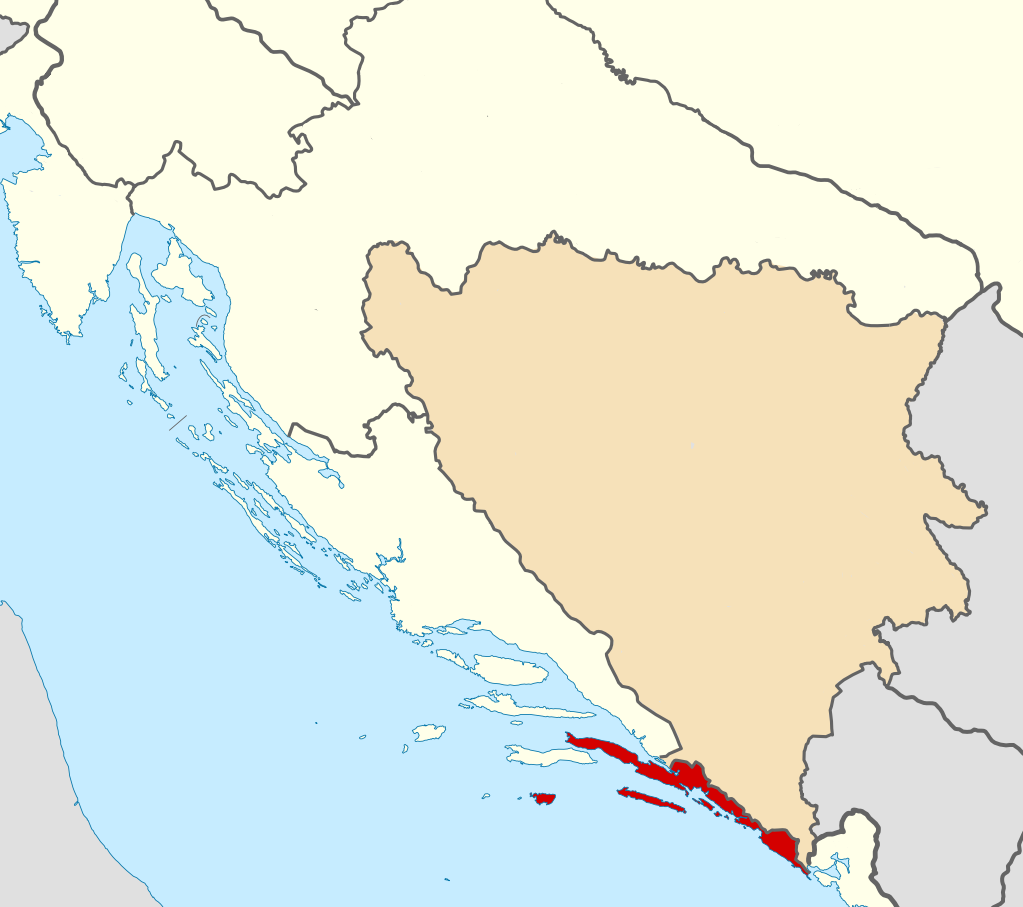
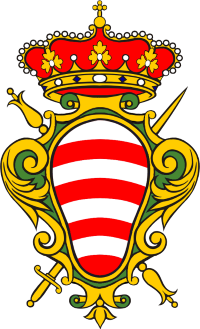
Originally a Roman settlement founded in the 7th century, the city remained under Byzantine control until the Fourth Crusade, where it was made to bend the knee to Venice 3. A much better outcome than Zara just up the coast, or Constantinople for that matter. . While under Venetian suzerainty it adopted a number of Venetian institutions and the future political system shows clear signs of this influence. It retained a large amount of local autonomy as the Venetian count ruled through and with local nobles. This arrangement lasted for 150 years before Ragusa leveraged a war between Venice and the Kingdom of Hungary to secure independence as part of the 1358 Treaty of Zara kicking Venice out of the Adriatic coast. Ragusa pledged allegiance to the King of Hungary and agreed to pay him tribute, adopting Hungarian colors into their coat of arms. However, by the time negotiations were finished they had achieved de facto independence.
In the 15th century when the Ottoman Empire swept into the Balkans, Ragusan diplomats were able to negotiate a very similar outcome: They agreed to ‘submit’ to the Sultan and pay him an annual tribute. In exchange, they were given a guarantee of protection, maintained almost total autonomy in foreign affairs and their ships would continue to sail under the Ragusan flag. The next two centuries were the ‘golden age’ of the republic as it prospered alongside the Ottomans.
A devastating earthquake in 1667 marked a clear turning point in the fortunes of the republic. Most of the city was levelled, the Rector and half of the nobility were killed with a total death toll somewhere around 3000-5000. The city was rebuilt in the baroque style of the day, but the republic entered a long period of decline as changing patterns of global trade diminished the importance of the Mediterranean and its ports. This decline was finally complete in 1808 when Napoleon formally declared an end to the republic and annexed it.
During the 15th and 16th centuries, Ragusa prospered on the back of sea-based trade. The republic’s geographic location made it a major seaport connected to land-based trade routes passing through the Balkans, and its diplomatic situation meant Ragusan merchants had almost unrestricted freedom to trade within the Ottoman Empire.
Ragusa traded heavily in the Adriatic, Mediterranean and beyond: Ragusan ships made enough of an impression on the English that Argosy 4. I would be amiss if I did not mention it appears in the Merchant of Venice. (a corruption of ‘Ragusa’) entered the language as a byword for merchant ship. It boasted one of the largest commercial navies in Europe, having a commercial fleet of 132 ships employing around ~3000 sailors in 1539-44, growing to 182 ships, 5500 sailors, and more than double the carrying capacity by 1570-85. Bašić, Đivo. “Shipping in Dubrovnik between the fifteenth and seventeenth centuries.” Pomorski zbornik 53, br. 1 (2017): 93-141. doi:10.18048/5307 This trade fleet was supported by a network of diplomatic services, there being 50 consulates across the eastern and western Mediterranean. Its shipbuilders were said to be up there with the best and comparable to the English or Portuguese.
In terms of total size, the republic was only ever a minor player in history. In the mid 16th century it had a population of a little over 50,000 for the entire republic, with some 8000 of these living in the city. It may have had an early peak of 90k total, but this was largely driven by refugees. See: Vekarić, Nanad. “The Population of the Dubrovnik Republic in the Fifteenth, Sixteenth and Seventeenth Centuries.” Dubrovnik annals 2 (1998): 7-28.
Despite its modest size, the republic maintained its autonomy for 450 years through skilled diplomacy and was well ahead of the curve when it came to laws and institutions. Highlights include:
-
Effective town planning which balanced out private and public interests in the interest of civic harmony. This and the following draws heavily from Robin Harris, Dubrovnik: a history. There were regulations to cover the problems of fire, sanitation, structural collapse and, in particular, disputes between neighbours. For example, the upkeep of the streets was divided between the residents on either side (one third each), while the central third was the responsibility of the commune.
-
By 1415 it had fully paved streets, each household and shop was required to clean the street in front of their premises once a week and there was staff of 4 street cleaners paid for by the city.
-
An almshouse was opened in 1347 and an orphanage opened in 1432.
-
By 1438 It had a water supply system where aqueducts supplied public fountains.
-
An effective legal code and court system with very good laws around shipping and commerce. It passed a maritime insurance law in 1568 one of the first in the world.
-
It had some of the first quarantine laws in Europe. From 1377 it was imposing a 30 day
quarantinetrentina on sailors, merchants, and goods. -
The slave trade was abolished in 1418.
-
The city supplied free medical care to anyone living in the territory. From as early as 1280 it had its own doctor who was paid a salary out of the public purse. This salary was on the condition that all who came to him from the city or district were treated without charge.
-
In the hinterland serfdom was not recognised by Ragusan public law nor promoted by the Ragusan state. It was possible to enter into a contract and agree before a notary to become the lord’s ‘man’ in perpetuity. Exactly how much servitude this implied varied from case to case and a man might expect a house and garden to cultivate himself in exchange.
-
World-class defensive walls that were not breached in half a millennium, and a commerce focused outlook that meant it also engaged in no attempts to expand its territory via military force. Havrylyshyn O., Srzentić N. (2015) “How Unique Was Ragusa? Some Comparisons with Venice and Others.” In: Institutions Always “Mattered”. Palgrave Studies in Economic History. Palgrave Macmillan, London. doi:10.1057/9781137339782_14
I hope the above has whetted your appetite to know more about the city. My next post will be a dive into its political system, one that Englishmen like J.S. Streater 5. Referring to J.S. Streater quoted in the epigraph. were interested in learning from in the 1660s.
D.S.